
An Invitation to Safety Conversations - Book review
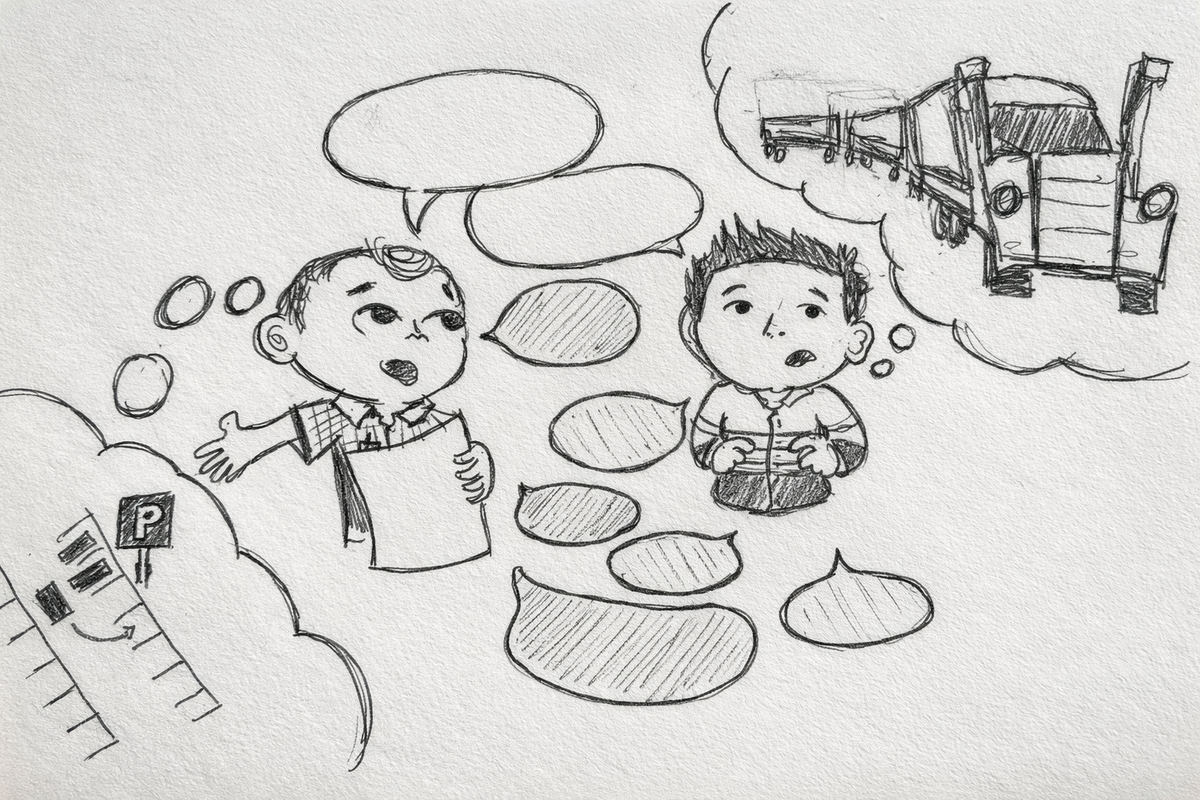
While reading An Invitation to Safety Conversations I often found my mind wondering what it is Daniel is describing here. To be clear, the book talks about safety conversations, as the title promises. It gives an introduction of why conversations are important, types of conversations, and how to take conversations further (in multiple ways). That part is clear. The question that haunted me was, what is it that these safety conversations, Daniel-style, do. What is the thing that it facilitates? Daniel uses the metaphors of organisations hearing and seeing themselves, which doesn't quite do it for me. The metaphor too much suggests a narrow purpose or one way street, compared to the examples in the book. Then I remembered Hanne Ørstavik's description of writing a book, about how writing allows different events or layers to meet. Conversations are not just a way for a centralised, high-up person to learn about the shop floor, but how any parts that need to come together can meet. Here An Invitation to Safety Conversations deviates from most safety books that talking about systems or processes, and instead, Daniel offers conversations that provide the grease that allows parts to meet successfully. This could be greasing interactions within systems and processes, or greasing parts that need to come together in a new way when an existing system is failing.
Funnily enough, allowing different parts to meet, is also a good way to describe my experience reading this book. Daniel is a long time friend. We have worked together trying to put safety ideas into practice. Even long after we stopped working together, we would still have discussions on many things, including ideas close to this book. I knew I would be sympathetic to Daniel's ideas, but expected there would be some differences how we treat findings. Daniel tends to let story more speak for itself. Myself, coming from a more ethnographic tradition, lean more towards researchers taking an active role, taking charge of the analysis and taking the audience along towards a conclusion I want to make.
On a high level, Daniel's ideas and direction were indeed familiar to me. However, multiple times I was surprised by details or particular passages that captured parts that had never come up in our discussions. Some experiences Daniel describes in the book really struck home, and reminded me of my own experiences figuring out how to study everyday work. Where he describes situations of initial hostile reaction to his presence, an unexpectedly emotional disclosure, or seemingly off-topic comments, I recognised his feeling of an immediate urge to turn away to smooth things over. I have been there. Unsure what I was actually supposed to do, being hit by something and scrambling to redirect, preferably with a sleight of hand, to a topic that was easier to handle. In those situations, I have done both what Daniel warns against, giving in to that feeling and turn away from what is presented, as well as what Daniel implores, staying with the issue and having the courage to be present with what is offered. Even as I had experienced the power of staying previously, I had never paused to put these experiences together to fully realise what was going on, let alone put it into words. By having these experiences connected in words, it becomes easier to recognise when it is happening, and to know what to do next time.
I expect that for many readers the knowledge in this book resides on a similar level. We have all had lots of conversations. We know they can go very different ways, but have rarely reflected on the variety of conversations. Some parts of the book will feel new, or might help people look further, but a lot of the book helps to put things already known together differently or more strongly.
This ability to make you think about what you kind of know matches with Daniel's writing style. Daniel does not throw a lot of big words, theories, or dense technical language around that leave you feeling dwarfed. Daniel very much writes experience first, putting events and lessons together to meet 'problems' you encounter in a conversation, and only occasionally adding explicit references to concepts or theory.
This is not to say there is no theory or larger worldview informing the ideas in the book. You can definitely find some safety differently-like concepts (he did create the original blog) in there, like sensemaking, adaptations, and his frustrations with overly rigid systems. There are some social psychology terms, like us/them divides. On a point of personal theoretical disagreement, Daniel describes patterns as out there to be discovered. My view is closer to the idea that we construct the patterns. That people play a noticeable role in what conversations are even possible, and which patterns they end up with. It's a small difference, but traceable. This links to my ethnographic experiences, with the conversations becoming richer during a project, and how much effort it takes to create descriptions or structure the findings. This difference in our positions is likely why Daniel ended up with the metaphor of organisations hearing themselves, while I prefer the grease that makes parts successfully meet. There are theoretical positions informing Daniel's work, even if it's is not immediately obvious.
The last chapter of the book takes this experience first approach the furthest. In the previous chapters, Daniel had gone through what conversations are, why they are important, covered different types of organisations from connection to accountability, how to make conversational organisation and leadership, relying on his experiences to introduce you to the ideas. But then in the last chapter, Conversational Mastery, Daniel hands it back to the reader. He suggests to experiment and see what your own experience tells you when it meets the ideas from this book.
While the book is not tightly bound to any safety tradition, a positive human psychology permeates it, and likely won't appeal to people who are dead set on seeing people as a hazard. Daniel is certainly not the only person bringing a human element to safety, and as such it might be helpful to position the book in relation to some others in this space. There is sociology-inspired work, like Martin Flinterman, who explains the complexity that arises in human systems and offers new ways to view challenges in safety, but focussing on these larger systems can make individual experience hard to find, something that is central in this book.
Closest to Daniel, is likely Steven Shorrock. His long-running blog *Humanistic Systems*, however leans a bit more towards 'experience of the human condition', while Daniel is closer to the 'experience in the moment'. Then there is the more anthropological and psycho-analytic flavour of Nippin Anand and the SPoR, putting a heavy emphasis on theory to highlight aspects of the human condition that are often glossed over.
Overall, this makes An Invitation to Safety Conversations the closest of these authors to everyday practical experience. For safety professionals who want to put it into practice, this makes it easy to understand and put into practice. Where I expect people might struggle a bit more is in the parts where it starts to go beyond an individual. The book does offer advice to team leaders on creating conversational teams and organisations. But as something to cultivate, not implement. The book does not offer tools, systems, or off-the-shelf solutions. In the end, it is a safety book that is not about systems. It is a book about the grease that lets parts meet successfully.